
PRODUCTRADAR • MATTRESS BUYING GUIDE
Memory Foam vs Hybrid Mattresses: Which Is Better for Your Needs?
Choosing between a memory foam mattress and a hybrid mattress? Explore how they compare in comfort, support, cooling, motion isolation, durability, and price so you can make a more informed buying decision.
Quick Answer: Memory Foam or Hybrid?
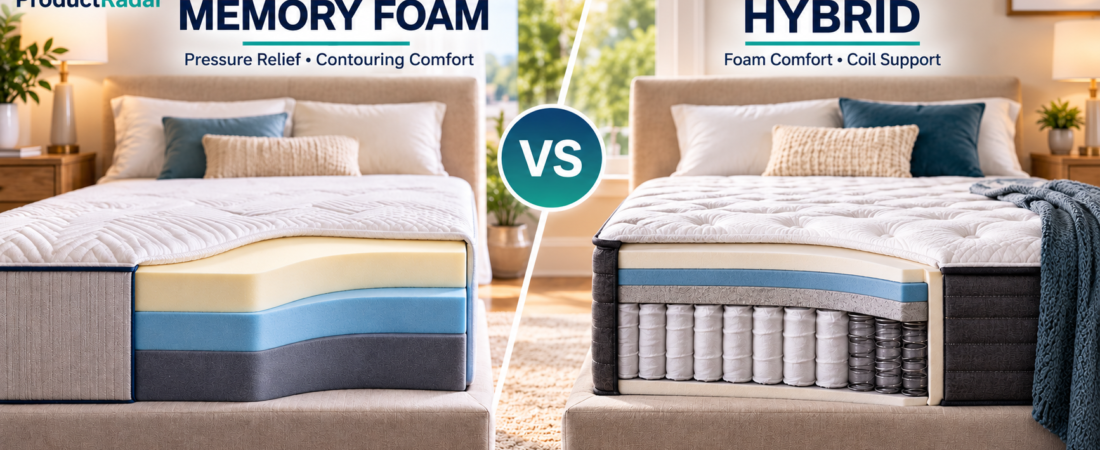
Memory foam mattresses are often a strong choice for sleepers who prioritize pressure relief, body contouring, and reduced motion transfer.
Hybrid mattresses may be more appealing to sleepers who prefer a responsive surface, stronger edge support, and potentially better airflow through a coil support system.
Neither mattress type is universally better. The right choice depends on your sleeping position, comfort preferences, body weight, temperature sensitivity, and budget.
What Is a Memory Foam Mattress?
A memory foam mattress uses layers of foam designed to respond to pressure and distribute body weight. Many models combine a memory foam comfort layer with denser support foam underneath.
For a more detailed explanation of this material, see the Sleep Foundation’s guide to memory foam .
For a closer look at a specific memory foam mattress, explore our Loom & Leaf Mattress Review & Comparison Guide to learn about its construction, firmness options and key buying considerations.
The characteristic contouring feel can help reduce pressure around areas such as the shoulders and hips. However, the degree of sinkage and firmness varies considerably between products.
Potential Advantages
- Close body contouring and pressure distribution.
- Often effective at reducing motion transfer.
- Usually quiet because there are no metal coils.
- Available in a broad range of firmness levels.
Potential Limitations
- Some models may retain more body heat.
- Deep contouring can make repositioning harder.
- Edge support varies and may be less substantial.
- Lower-density foams may soften or develop impressions sooner.
What Is a Hybrid Mattress?
A hybrid mattress typically combines a coil-based support system with comfort layers made from foam, latex, or other cushioning materials.
Many hybrids use individually wrapped coils to provide targeted support while limiting some movement across the mattress.
Because hybrid designs vary widely, some feel plush and contouring while others feel firmer and more responsive.
Potential Advantages
- Responsive support that may make movement easier.
- Coil systems can promote airflow.
- Many models offer reinforced perimeter support.
- Available in soft, medium, and firm configurations.
Potential Limitations
- May transfer more movement than all-foam designs.
- Some models are heavier and harder to move.
- Premium hybrids can be relatively expensive.
- Performance depends heavily on coil and comfort-layer quality.
Memory Foam vs Hybrid Mattress: Key Differences
| Feature | Memory Foam | Hybrid |
|---|---|---|
| Overall Feel | More contouring and cushioning | Often more responsive and buoyant |
| Pressure Relief | Often a key strength | Depends on comfort layers |
| Motion Isolation | Generally very good | Varies by coil design |
| Cooling | Depends on foam and cover design | Coils may improve airflow |
| Edge Support | Varies by foam construction | Often stronger in reinforced models |
| Ease of Movement | Can feel slower to respond | Often easier to change positions |
| Price | Wide range, including budget models | Wide range, with many premium options |
| Durability | Depends on foam quality and density | Depends on coils and comfort layers |
These are general tendencies rather than guarantees. A well-designed memory foam mattress may outperform a lower-quality hybrid in several categories, and vice versa.
Which Mattress Is Better for Your Sleeping Position?
Side Sleepers
Side sleepers often benefit from cushioning around the shoulders and hips. Memory foam can be appealing, although softer hybrids may offer similar pressure relief.
Back Sleepers
Back sleepers may prefer balanced cushioning and support. Both mattress types can work when the firmness level helps maintain comfortable spinal alignment.
Stomach Sleepers
Stomach sleepers often prefer a more supportive surface that limits excessive sinking around the midsection. Firmer versions of either type may work.
Combination Sleepers
People who change positions frequently may appreciate the responsive feel of a hybrid, although some firmer all-foam mattresses also allow comfortable movement.
Which Mattress Sleeps Cooler?
Temperature regulation depends on more than the mattress category. Foam composition, fabric covers, room temperature, bedding, and individual preferences all influence sleeping comfort.
Traditional memory foam can retain heat because it contours closely to the body. Some newer foam mattresses use ventilated layers or other temperature-management materials.
Hybrid mattresses often allow more air movement through their coil systems, which may help sleepers who prefer a less enveloping feel.
Which Mattress Is Better for Couples?
Couples often consider motion isolation, edge support, available sleeping space, and individual firmness preferences.
Memory foam typically absorbs movement well, making it worth considering when one partner is easily disturbed by the other’s movements.
Hybrids with individually wrapped coils can also limit motion transfer while providing a more responsive surface and, in some models, stronger edge support.
Durability: Which Mattress Lasts Longer?
There is no reliable universal winner. Mattress lifespan depends on construction quality, material density, coil durability, frequency of use, sleeper weight, and maintenance.
For memory foam, examine the quality and density of the support and comfort layers when that information is available.
For hybrids, consider both the coil system and the durability of the cushioning materials placed above it.
A generous warranty can be helpful, but it is important to review what is actually covered, including body-impression thresholds, exclusions, and claim requirements.
Price and Overall Value
Both mattress types are available across budget, midrange, and premium price segments.
All-foam models can offer accessible entry-level options, while complex hybrid constructions sometimes command higher prices. However, brand positioning and materials can make either type expensive.
Instead of choosing based on price alone, compare the mattress specifications, return policy, trial period, warranty, shipping terms, and any additional fees.
What to Check Before Buying a Mattress
- Firmness: Choose a feel that matches your comfort and support preferences.
- Materials: Review foam types, coil construction, cover materials, and available specifications.
- Sleep trial: Confirm the trial length, return eligibility, and any return or pickup charges.
- Warranty: Read the actual warranty terms rather than relying on the advertised duration.
- Foundation requirements: Verify that your existing bed frame or base is compatible.
- Customer feedback: Look for consistent patterns across multiple credible sources.
Frequently Asked Questions
Is memory foam better than a hybrid mattress?
Not necessarily. Memory foam often appeals to people seeking contouring and motion isolation, while hybrids may suit those who prefer responsiveness and coil-based support.
Are hybrid mattresses good for side sleepers?
Yes, depending on their firmness and comfort layers. A hybrid with sufficient cushioning may provide the pressure relief many side sleepers prefer.
Do memory foam mattresses sleep hot?
Some do, but temperature performance varies by construction, ventilation, bedding, and individual sleeping conditions.
Are hybrid mattresses more durable?
Not automatically. High-quality materials and construction matter more than the mattress category alone.
Which mattress type is better for couples?
Memory foam can be advantageous for motion isolation. Hybrids may offer a balance of motion control, responsiveness, and reinforced edge support.
Final Verdict: Which Should You Choose?
When comparing a memory foam vs hybrid mattress, consider memory foam if your main priorities are close contouring, pressure relief, and limiting motion from a sleeping partner.
Consider a hybrid if you prefer a more responsive mattress, easier repositioning, or the potential airflow benefits of a coil support system.
Ultimately, the best mattress is one that fits your comfort needs, preferred firmness, sleeping habits, and budget. Comparing specific models is more useful than assuming one entire category is superior.
About this guide: This article provides general consumer information and is not a substitute for individualized medical advice. Product features, policies, and availability may change. Always verify current details with the manufacturer or retailer.
Explore more independent research in our Product Guides & Reviews section.